Off-Cuts to Heirlooms - The Story Behind Our Linen Patchwork Quilts
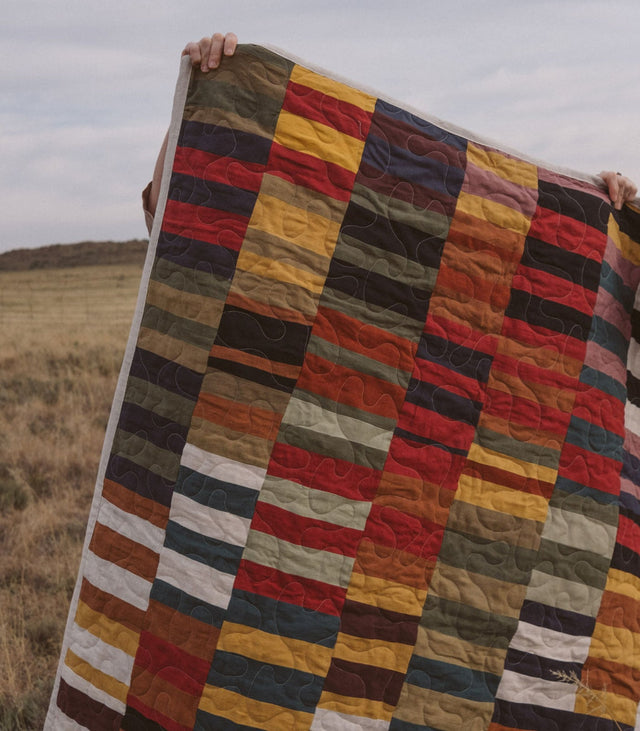
Every Titch patchwork quilt starts with a bag of linen that is leftover from the normal production process. Offcut linen comes from the strips trimmed from a shirt, the edges cut from a tablecloth, and the pieces that are too small to use for anything else. What’s left are pieces of linen in all shapes, sizes, colours, and weights.
The process of making our patchwork quilts is long, carefully coordinated and, more importantly, depends on many skilled individuals including small, female owned businesses independent of the Titch team. This helps us stay true to our ethos of supporting local talent, community upliftment, and sustainable fashion and homeware.
We value every person and the role they play in the process of making these gorgeous linen patchwork quilts.

Sorting, Ironing, and Cutting the Scraps
The first job is sorting through the bags and making sense of what's there. Pieces get grouped loosely by colour and weight, then ironed flat. since linen comes out of a bag creased and uneven and needs to be smoothed out before it can be measured properly.
From there, the pieces are cut into strips and squares using a rotary cutter and a cutting mat, and sized according to whatever the finished design calls for. A step that takes time, patience, and precision. Because the offcuts come in all shapes and sizes, getting a clean, usable strip out of an oddly shaped scrap means a fair amount of trimming and re-trimming. Some pieces will be cut down further; others won't make the cut at all and get set aside for something smaller, like a cushion or a zipped purse. We ensure that nothing goes to waste if it can still be used for something.

Piecing the Patchwork Panels
Once the pieces are cut, they're sewn together into patchwork panels using a small but trusty sewing machine, strip by strip, square by square.
Each panel comes together according to whatever colours are on hand that day. There's no fixed pattern being repeated from quilt to quilt, just a sense of which colours sit well next to each other and how the proportions should work. Once a panel is finished, the seams get pressed flat and the edges trimmed to size, paying extra careful attention to the finest detail.

Laying Out the Final Design
This is the step where the quilt starts to take shape. The finished panels get laid out across the full design, and decisions get made about where each colour and each strip should sit so the whole design comes together as one intentional piece rather than a random collection of fabric.
It's also the step that guarantees no two quilts will ever be the same. Once the layout is settled, the panels are sewn together in the workshop to form the complete quilt top.
Batting, Backing, and the Quilting Stitch
With the patchwork top complete, it's layered with high quality wool batting and a piece of colour coordinated linen on the back. The wool batting adds warmth and a bit of extra weight, while the linen backing gives the quilt a clean, finished underside that feels cozy and luxurious to the touch.
From there, the three layers are sent off for the quilting stitch, the line of stitching that runs through all three layers and holds them together evenly so the batting stays in place. Once that's done, the edges are bound to finish the quilt off properly and protect the raw edges from wear.

A Quilt That Will Never Be Repeated
Textile waste is one of the heaviest costs of the fashion and homeware industry. Off cuts from clothing and homeware production get thrown away constantly because reusing them properly takes time, patience, and a willingness to work with whatever colours and shapes are left behind from normal production processes. The fast fashion industry doesn’t have the time for that.
A patchwork quilt made this way takes considerably longer to produce than a mass-manufactured one, and it costs more as a result. That cost reflects the sorting, the cutting, the hand-piecing, the layout decisions, and the skill it takes to turn a pile of mismatched off cuts into a finished design that is functional and 100% unique. It's not a price built on volume. It's a price built on time and skilled craftmanship.
What you get for that is a quilt that exists nowhere else in the world, made sustainably from fabric that could otherwise have gone to landfill, and beautiful enough to be the first thing someone notices in a room.
Titch — Linen Patchwork Quilts and Linen Homeware
Our linen quilts come in two colour options: monochrome our multi-coloured. They are made to order and take around 6 weeks to produce. You can choose between three different sizes including baby, small, and large but if you would like to discuss a custom size please don’t hesitate to contact us – we are here to make your patchwork dreams come true!